
WASHINGTON 鈥斅燞ad your fill of politics for a while? Not to worry, as this Tuesday we have a trio of super sky events to take your mind off the continuing election year.
To update of asteroid 2013 TX68 to our planet: a anywhere from 15,000 miles to 3 million miles. This wide range is due to lack of sufficient observations to precisely define the space rock鈥檚 orbit, but a clear miss was assured.
鈥�2013 TX68 safely passed by Earth on Monday morning. According to the Minor Planet Center, the space rock鈥檚 closest approach occurred on March 7 at 13:42 UTC (8:42 ET) at a distance of 2,542,960 miles (4,092,497 km) from Earth, just a bit closer than the nominal 3 million miles previously estimated,”聽a .
Although the space rock safely passed us by, the Internet is still abuzz with . If 2013 TX68 had entered the Earth鈥檚 atmosphere, it would have released about twice the energy of the .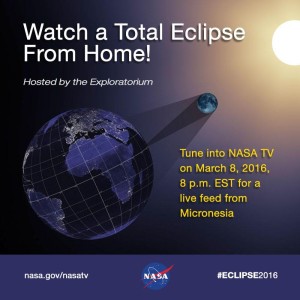
There is a total solar eclipse for areas of the Pacific and Indonesia聽taking place on Wednesday聽in their聽time zones, but occurs Tuesday聽in ours. We can鈥檛 see the eclipse in the DMV but we can watch it live (and safely) on the Internet via at 8 p.m. EDT.
If you happen to be reading this in an area that the eclipse is occurring, make sure you view the eclipse safely聽by following . Failure to do so can result in injury to your eyes.
Be sure to tune in at 1 p.m. Tuesday for a Reddit Ask Me Anything session as solar scientists from NASA’s Goddard Space Flight Center in Greenbelt, Maryland, will be taking questions on the eclipse and the .
will be August 21, 2017 and will occur in the United States. I will have much more on this as we get closer to the event.
If you have been outside at night recently when the skies are clear, you may have noticed a very bright 鈥渟tar鈥� in the East. That 鈥渟tar鈥� happens to be the planet Jupiter, and it will be rising at sunset Tuesday聽as it is at opposition, or directly opposite the sun.
King of the planets, mighty Jupiter will be in our sky all night in the coming months and will be the brightest object in the night sky 鈥� second only to the moon.
A pair of binoculars can show the discovered by Galileo in 1610 and any quality telescope will reveal details in the atmosphere of the gas giant planet.
You can determine which moon is which by . It’s pretty cool to watch the moons change their positions as the night goes on.
Follow my daily blog听补苍诲 to keep up with the latest news in astronomy and space exploration. You can email me at skyguyinva@gmail.com.


