
WASHINGTON — By trading two-time All-Star pitcher Tyler Clippard to the Oakland Athletics Wednesday night in exchange for infielder Yunel Escobar, General Manager Mike Rizzo and the Washington Nationals finally addressed their weakest position — second base.
Or did they?
There are two ways to look at the move — one which indicates the club has what it wants heading into spring training in a month, the other suggesting that the biggest move of the off-season may be yet to come.
Escobar brings a . But he has played almost exclusively at shortstop, starting 986 of his 1,016 career games there. He hasn鈥檛 played second base since 2007, as a 24-year-old.
Of course, it hasn鈥檛 been long since the Nats have taken a career shortstop and transitioned him to second base. Asdrubal Cabrera — whom Rizzo traded for, and who signed with Tampa Bay earlier this offseason — hadn鈥檛 played second base since 2009, but was used almost exclusively there as a National. It generally stands to reason that if you accomplish the tasks required of a shortstop, you can manage at second base as well.
If that鈥檚 the case, Washington now has a 32-year-old second baseman under team control through at least 2016 (with a $7 million option/$1 million buyout for 2017) who has slashed .256/.318/.350 and 2.0 WAR over the past three years. That鈥檚 not bad, but it鈥檚 not all that much better than what incumbent Danny Espinosa has done. And considering Escobar鈥檚 left/right splits are nearly identical, he doesn鈥檛 seem to make that much sense in a platoon with Espinosa. He鈥檚 essentially a non-flashy, reliable, relatively low-cost stop gap ($2.5 million cheaper this year than Cabrera).
Or, he鈥檚 the Opening Day shortstop.
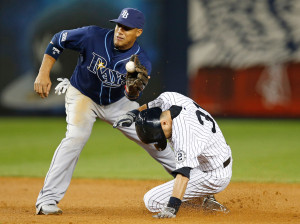
The Nationals have not been shy about dangling Ian Desmond in trade talks this off-season, with the longest-tenured player in the organization first linked in a potential deal to Seattle, then in three-way talks with the Mets and Rays, which would have landed him in New York. Desmond will hit free agency after the 2015 season, and there has been little traction to sign him to a long-term extension. Desmond was presented with a multi-year extension prior to last season, but at a rate even a high-ranking Nationals official admitted was聽well below his open-market value.
Factor in the other trio of impending free agents (Doug Fister, Denard Span, Jordan Zimmermann) and the willingness to deal Clippard, who is in the same boat, a Desmond trade certainly seems feasible. A deal with the Mets, even though they’re a division rival, could also be the best fit, with Daniel Murphy — whom the Nats considered as a second base solution last season —聽as part of the return.
Parting with Desmond wouldn鈥檛 be easy. He鈥檚 amassed the highest fWAR among major league shortstops the past three years (14.0), well ahead of the next closest player at his position, the oft-injured Troy Tulowitzki (11.8). He鈥檚 averaged 23 home runs and 22 stolen bases in three straight 20/20 campaigns. And he鈥檚 one of the more vocal, stand-up leaders in .
He鈥檚 also , the organization鈥檚 most comprehensive community effort since moving to D.C. in 2005.
In a conference call Wednesday, Rizzo said 鈥淚an Desmond is our shortstop. He鈥檚 the leader of our team. He鈥檚 one of the best shortstops in baseball.鈥�
All of these things are true. But Rizzo did not also say 鈥淲e are not trading Ian Desmond.鈥�
Not that he needs to. Closing the door on potential options isn鈥檛 good business, or Rizzo鈥檚 M.O. But for all the seeming vote of confidence, his statements Wednesday don鈥檛 change the situation he finds himself in. As and FOX Sports鈥� Ken Rosenthal (albeit more from the Mets鈥� perspective), it鈥檚 worth looking at the pros and cons of such a deal.
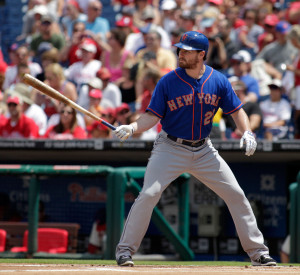
On paper, Escobar appears to give the Nats a more solid, less spectacular defensive shortstop than Desmond. Escobar has made a total of 35 errors over the past three years at short, amassing a .980 fielding percentage. Desmond, meanwhile, has made 59 miscues, good for a .968 mark. Fangraphs gave Desmond a combined 28.1 runs saved above average since 2012, while Escobar had marks of 10.8 in 2012 and 17.5 in 2013 before a disastrous -11.0 last season.
Defensive metrics are not as advanced as offensive ones in baseball, and can be fickle from year to year, but generally the two seem to be comparable on that front. It鈥檚 the offense that clearly sets them apart. That鈥檚 where looking at the difference in what Murphy might bring at second base (both in regards to Escobar and Espinosa, his likely replacement if the former moved to shortstop) helps us see whether there鈥檚 positive value in a trade.
Murphy has posted remarkably similar numbers the past three years, slashing .288/.327/.407 while averaging 9 home runs, 38 doubles and 15 stolen bases. He also brings a needed left-handed bat, potentially adding value as a partial platoon with Espinosa, who still crushes lefties. His defense has always left something to be desired, though, netting -18.4 runs over that time, per Fangraphs. That has left him with a 7.1 fWAR over that span, only marginally higher than Escobar鈥檚 5.5.
With Escobar trying to replace Desmond in this scenario, it seems to leave the Nats at a net loss in WAR. Even if they were able to get another prospect in the deal, Murphy is also a free agent after this season, so Washington would only have one year of team control. Barring the inclusion of a major prospect in the deal, the net loss for the 2015 club doesn鈥檛 seem to be worth trying to salvage something out of Desmond鈥檚 value. But if that major prospect becomes available, whether from the Mets or another club, don鈥檛 put it past Rizzo to make a deal where he finds good value.
Follow and on Twitter and .


